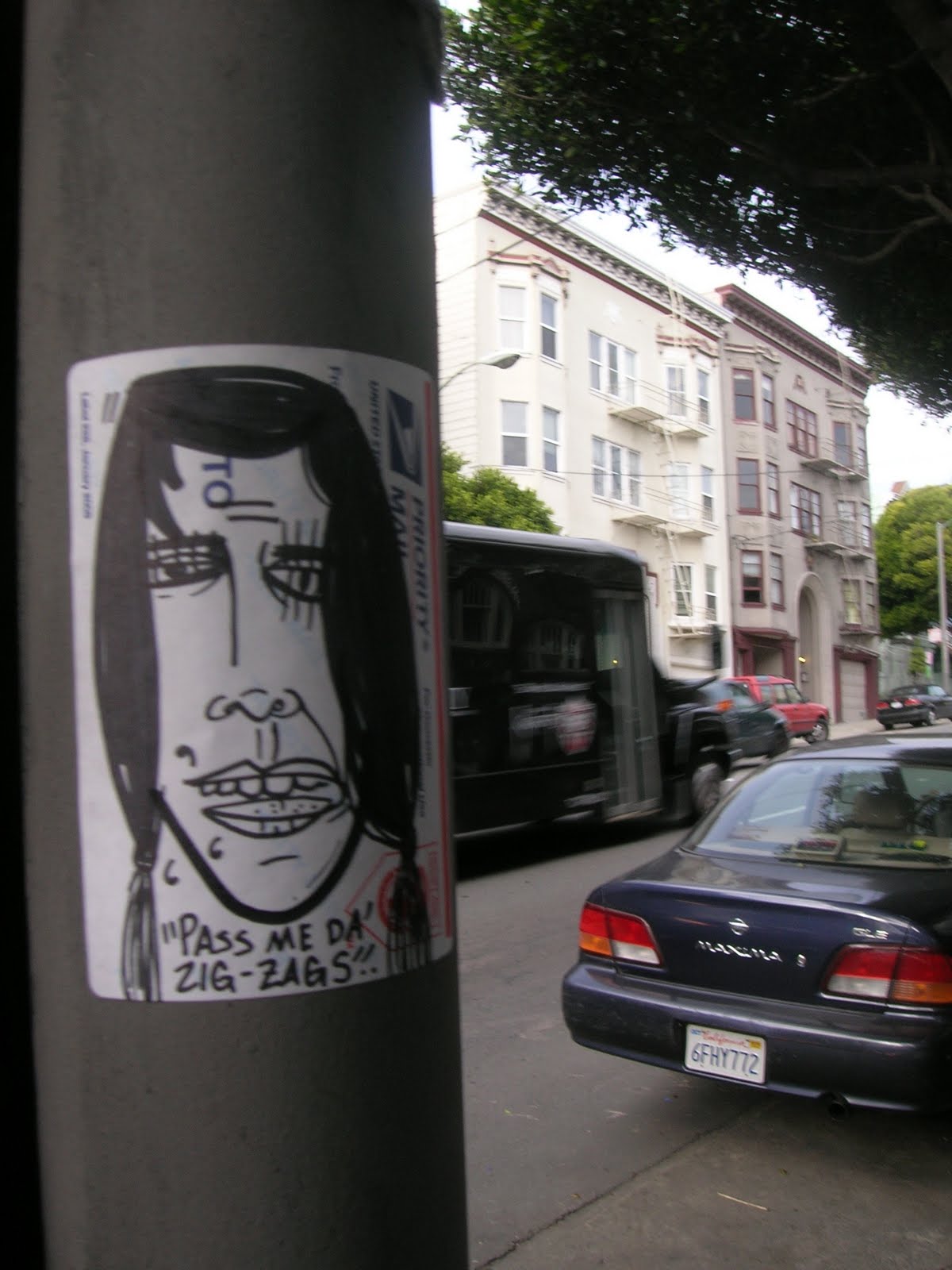
Due to some technological difficulties, today's ProFile will be in a weekday kind of format. Fortunately, Olivia has a lot to say about her work and the future of street art. She writes:

"I was born in Bilbao, north of Spain and I've been living in Barcelona for the last 15 years. I always liked that name, I used it as a nickname on Internet, so that was a name I felt comfortable with and using olive-oil character. Olivia as a subject came easily. I also look a little bit like her."
"Everywhere I go I try to take posters with me. Barcelona, Bilbao, Madrid, Granada, Valencia, Paris, London, Berlin, Istanbul, Lisbon. In Spain I really like Valencia, because you can find very good spots and it last forever, at least by now. In Europe I loved Berlin, amazing city and full of really good stuff; also Paris is not easy but they really like stencils and I feel they appreciate my work. Paris is like the capital of stencils and for some reason my work always has a little French touch. When I'm not pasting, I work as a textile designer for fashion companies and also as a teacher of plastic arts to High school students."

"I remember myself always drawing and painting with colour pencils when I was a child, when I grew up I use to do it at school instead of doing maths. I started painting on the street when I was already 35, so at that time I had already studied Fine Arts and I had my own style of drawing. What I took from the street was the technique of stencil that I had never used before, Barcelona 5 years ago was very inspiring because there was murals and works of people of all types, colours, techniques and sizes, that was amazing.
"I was introduced to street art by Mr Case four and a half years ago. He told me everything about it, even how to make a stencil. I can't forget how excited I was when I painted my first stencil on the street, them I realised that was a bit more dangerous than I thought, police, fines. I think my olivias are more elaborate now. I started doing simple 2 or 3 layer stencils. Now I put more elements in them and I use different techniques apart from stencils, like fabric, feathers, etc. "

"Street art is very exciting, not because you can get caught by the police, but because being out on the streets everybody can see your stuff and other artists can interact with you. Also because street art makes a city feel alive, public space is a common place where everyone should have the opportunity of express themselves as citizens, not just the big companies with ads always trying to sell something, democratisation of public space."
"Once I got caught by the police on a bombing night in the city. I was taken to court and my punishment was to spend some hours as a social worker doing something for the community. I ended up teaching kids how to paint graffiti in a small organization, they had to paint the shutters of the neighbourhood shops with graffiti related to the products that were sold in each shop. The project was really interesting, teaching the kids how to make a sketch before starting and how to paint together was very nice. It was strange to teach kids how to paint graffiti as a punishment for painting graffiti... But it was a beautiful projects and the kids were really happy with the final piece, and that's the important thing for me."

"Painting with friends makes you feel safer and more self-confident. Street art is not an easy thing to do, many people hate it, you have to be careful with the police, and you must get used to see your work destroyed, covered, ripped and trashed (good for educating your ego), so doing it with friends makes it less hard and more fun."
"I think the main difference between old-school graffiti and street art, apart from the technique itself (spray vs brush/sticker/poster/whatever), is that graffiti is done by writers for writers, while street art is more open to all kind of people. Tags and throw-ups are a close code of communication for people who are inside the scene. Actually, tags are very hard to read for people not familiar with graffiti-style letters, they are intended for other graffiti artist to see and appreciate. While anybody can understand and appreciate street art. That's why graffiti and tagging are more stigmatised and not so accepted by society, while street art is more generally accepted, because graffiti is a close code of communication, while street art is more open o anyone and easily understandable."

"I never tried to express any special meaning behind my work, but I think there's always something, a way of seeing life that goes within. My girls are very feminine, but strong and even pioneer in their times. Each of my Olivias represent a quality I consider important, a tribute not only to the person or character but also an attitude. Frilivia Khalo, for instance, represents courage and self-improvement; Oliphine Baker to be ahead of your time. Now I'm working for an exhibition in Menorca, it's opening soon so I must hurry and finish the last pieces!"
"When graffiti started your ego was very important, a graffiti writer looked for fame and recognition in the graffiti scene. I guess this is a kind of attitude that fits more with men than with girls... Men tend to be tougher and more self-confident, while women can be more insecure, in general. But there are more and more girls doing street art now, and there were also girls in the old-school days. I think that's very important, hip hop and street art needs some girls! I don't think much about it, my fellow boys never made me feel different for being a woman; but there's a different sensitivity and normally you see the difference in the art, but not always.It's true that being a girl generates curiosity from people, because there aren't so many girls in the street art scene. I don't feel I have to lead any cause, but I am a woman and express my feelings and maybe those of any other women as well. Powerful, sensitive, intelligent, tough, but feminine. I prefer a strong woman to the image of a fragile conventional girl, and that's what I try to represent with Olivia. You can be strong and very feminine at the same time."
Thanks so much, Olivia! For more photos, catch up with Mr. Case on his website. Right now, I'm gearing up for a World Cup-filled weekend. Nobody call me (unless it's to discuss the matches)!